Why product should own pricing
In short: At a startup, the product team should own pricing and packaging: running the process, pulling in input from sales, finance, marketing and customers, and staying accountable for results. The CEO makes the final call.
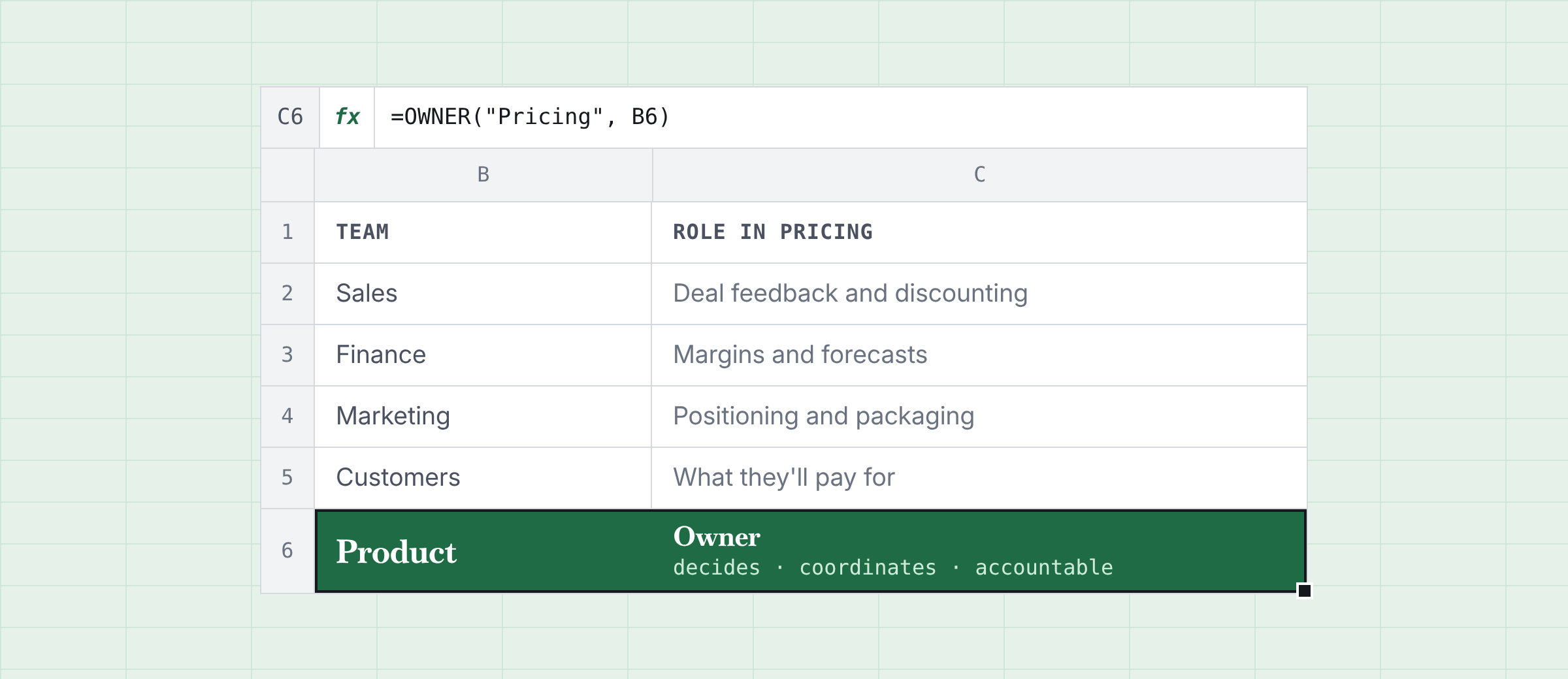
Pricing is one of the few decisions that touches every part of a company. Sales lives with it in every deal. Finance forecasts from it. Marketing has to explain it. Customers feel it every time they renew.
That's often why nobody quite owns it. It drifts between the founder, a sales leader and finance, and changes happen when someone has a strong enough opinion at the right moment.
I believe the product team should own pricing. To be clear, owning pricing isn't the same as having the final say. As with any major product decision, the CEO makes the call. Product should own the work and the outcome.
One post a month on pricing, growth and product. No spam, unsubscribe anytime.
Why should product own pricing?
Great product teams have to embody the intersection of technical, customer and business. They understand what's possible to build, what customers need, and how the company wins. Pricing is where all three meet.
Without pricing ownership, the business side of that intersection is the one that tends to get neglected. Teams focus on what's technically interesting or what customers ask for, and lose sight of how the product makes money. The relationships needed to drive business outcomes, with sales, finance and marketing, start to dwindle too, because there's no shared problem pulling the teams together.
Owning pricing keeps all three sides in view. Here's how.
It connects what the team builds to how the business makes money
Product teams can drift into a silo. They ship work that is technically impressive and well designed, but that doesn't translate into customer value or business results.
Owning pricing closes that gap. When the team is responsible for how the product is packaged and sold, it has to think through the commercials: who pays, for what, at what point in the journey, and how the sales process works around it. A feature stops being just a feature. It's something that should help win a deal, drive an upgrade or justify a price.
That shift changes the questions a team asks before it builds. Which plan does this belong in? Will it help us sell to the customers we're targeting? Does it give someone a reason to pay more? Those are the right questions, and pricing ownership makes them unavoidable.
It makes the team work across the company
Good pricing can't be built in a vacuum. It needs input from almost every function:
- Sales knows where deals stall, what competitors charge and which discounts are becoming the norm.
- Finance understands margins, revenue recognition and what the forecast can absorb.
- Marketing knows how the offer will be positioned and what customers will understand on a pricing page.
- Customers tell you, directly or through their behavior, what they value and what they're willing to pay for.
When product owns pricing, it becomes the central coordinator for all of these voices. It gathers the input, weighs the trade-offs and makes sure a change works for every team that has to live with it, from the sales deck to the billing system. That coordination is what lets pricing scale as the company grows, instead of fracturing into one-off deals and exceptions.
It creates a clear owner, and clear accountability
Pricing is something everyone wants to change and everyone has an opinion about. That's healthy, as long as there's someone responsible for turning those opinions into a coherent strategy.
Without a clear owner, pricing changes tend to be reactive. A big deal needs a special package. A competitor launches a cheaper plan. A board member suggests usage-based pricing. Each change might make sense on its own, but together they create an offering that's hard to sell and harder to explain.
A clear owner makes sure changes are thoughtful and strategic. They can say yes to the right ideas, say not yet to others, and explain why. And because one team owns the outcome, there is real accountability for whether a change actually moved the business.
Why not finance or marketing?
Product isn't the only team that could own pricing, and the alternatives come up often.
Finance is usually the next option. Finance brings rigor and a clear view of the numbers, but tends to think about pricing through margins rather than marketability. A price can protect margins on paper and still be hard to sell, confusing to buy, or out of step with how customers get value from the product.
Marketing is another option. Marketing understands positioning and how to tell the story on a pricing page. But when marketing owns pricing, it becomes disconnected from the evolving product roadmap. Packaging falls behind what the product can do, and new capabilities launch without a clear place in the offer.
Both teams are essential inputs. Product is the team that can weigh margins, marketability and the roadmap together.
Who makes the final pricing decision?
Ownership isn't about product making pricing decisions in isolation. It's about product running the process: collecting input, framing the options, testing where it can, making a recommendation and seeing it through launch.
The final call should rest with the CEO. As with every major product decision, the CEO is the decision maker, and pricing needs that authority even more than most. A pricing change ripples through sales, finance, marketing, support and billing, so it takes the CEO's backing to align the company and drive the change through.
The two roles depend on each other. Pricing evolution needs the authority of the CEO to succeed, and the CEO needs the product team to own the outcome. The CEO makes the decision and champions the change across the company. Product does the work to get there and stays accountable for whether it delivers.
How do you give product ownership of pricing?
- Name the owner and the decision maker. Make it explicit that product owns pricing and packaging, that the CEO makes the final call, and tell the rest of the company.
- Set up a simple process. Give sales, finance and marketing a clear way to bring pricing feedback and requests to the owner.
- Agree on what success looks like. Pick the metrics a change should move, such as conversion, average contract value, expansion or discounting.
- Review on a regular cadence. A quarterly pricing review keeps changes deliberate instead of reactive.
- Bring the company along. Share the reasoning behind each change so every team can explain it with confidence.
Pricing is too important to be everyone's side project. Give it a real owner, and make that owner the team closest to what customers value.